AuthorScout vs Jungle Scout: A Guide for KDP Authors
See how book-specific research differs from broader Amazon seller intelligence, with a practical workflow for evaluating your next title.
A product can sell well on Amazon without telling you much about the opportunity for a new independent book. Authors need to consider publication age, competing books, reader expectations, categories, and the history behind a sales rank. That is the context for comparing AuthorScout vs Jungle Scout.
AuthorScout focuses on discovering and investigating books. Jungle Scout serves a broader Amazon market, with Catalyst for independent sellers and other products for brands and organizations. This comparison concentrates on the publishing research decision, rather than treating every Jungle Scout product as one interchangeable plan.
The practical difference
| Your decision | AuthorScout | Jungle Scout |
|---|---|---|
| Primary context | Independent book publishing | Amazon products and seller businesses |
| Discovery example | Recent independent books with few reviews | Product opportunity research |
| Next decision | History, categories and book monitoring | Seller listing and growth workflow |
| AI and creation workflow | Research MCP plus separate guided Book Creator | Seller toolkit; enterprise MCP is a separate offering |
Understand which Jungle Scout product you are comparing
The Jungle Scout Catalyst page describes product discovery, keyword research, listing optimization, review automation, and browser-based research. Its main website also presents market intelligence for brands, including category benchmarking, pricing analysis, and enterprise data products.
Those capabilities can matter to a seller with a wider product catalog. For a KDP author, the decision should be narrower: which features help you evaluate a book idea, and which depend on a selling workflow you do not use? Compare the actual product and subscription you would buy, not a combined list from the entire company.
Find comparable independent books first
Imagine researching a practical home-organization book. Looking only at the largest established titles can make the market difficult to interpret. Their sales may reflect years of reviews, an existing audience, or a publisher’s distribution.
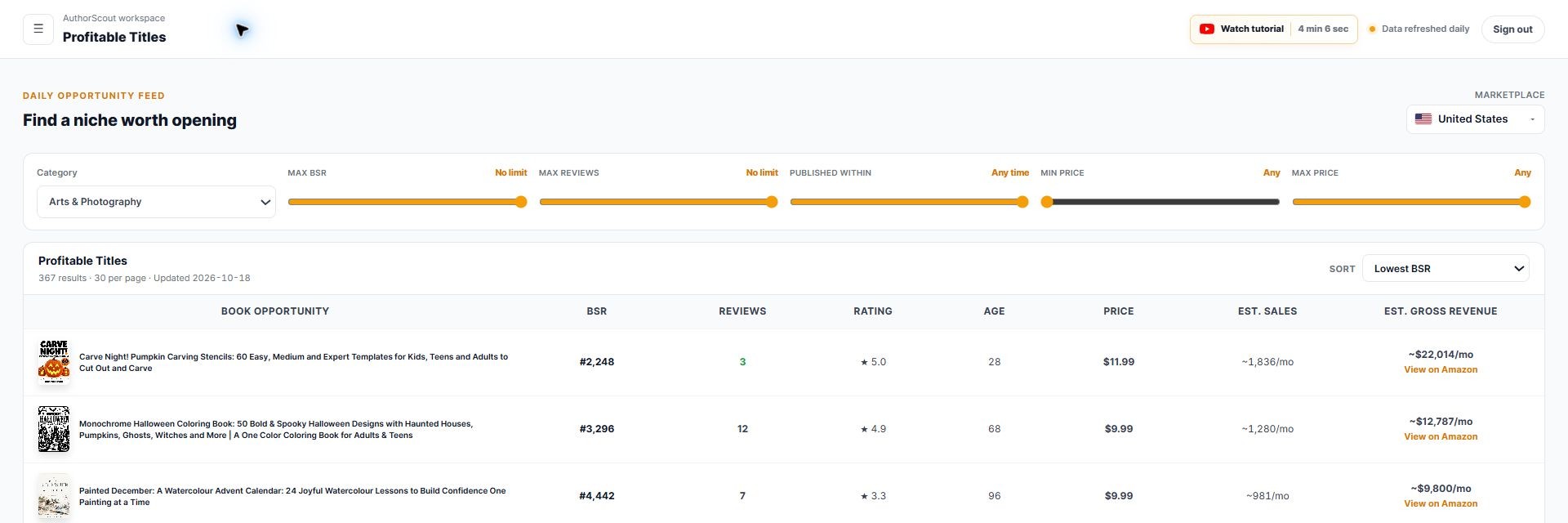
In AuthorScout, begin with a relevant niche in Profitable Titles. Filter the available books by publication age, review count, BSR, and price. Focus on independently published examples and ask whether newer entrants are showing sales activity.
- Recent books help you study what is happening among newer releases.
- Fewer reviews help separate early traction from a long-established review advantage.
- Rank and estimates help prioritize candidates, while publication age and price provide context.
Top Performing lets you change the order of the evidence; Title Search helps narrow a broad niche to a particular topic. You are making a manageable shortlist, not accepting a software label as a publishing decision.
Compare marketplaces without repeating the same searches
A subject that looks interesting in the US may behave differently elsewhere. AuthorScout’s discovery feed covers the US, UK, Germany, France, Canada, Spain, and Italy, subject to plan access and availability. You can explore a different discovery market from the same workspace.
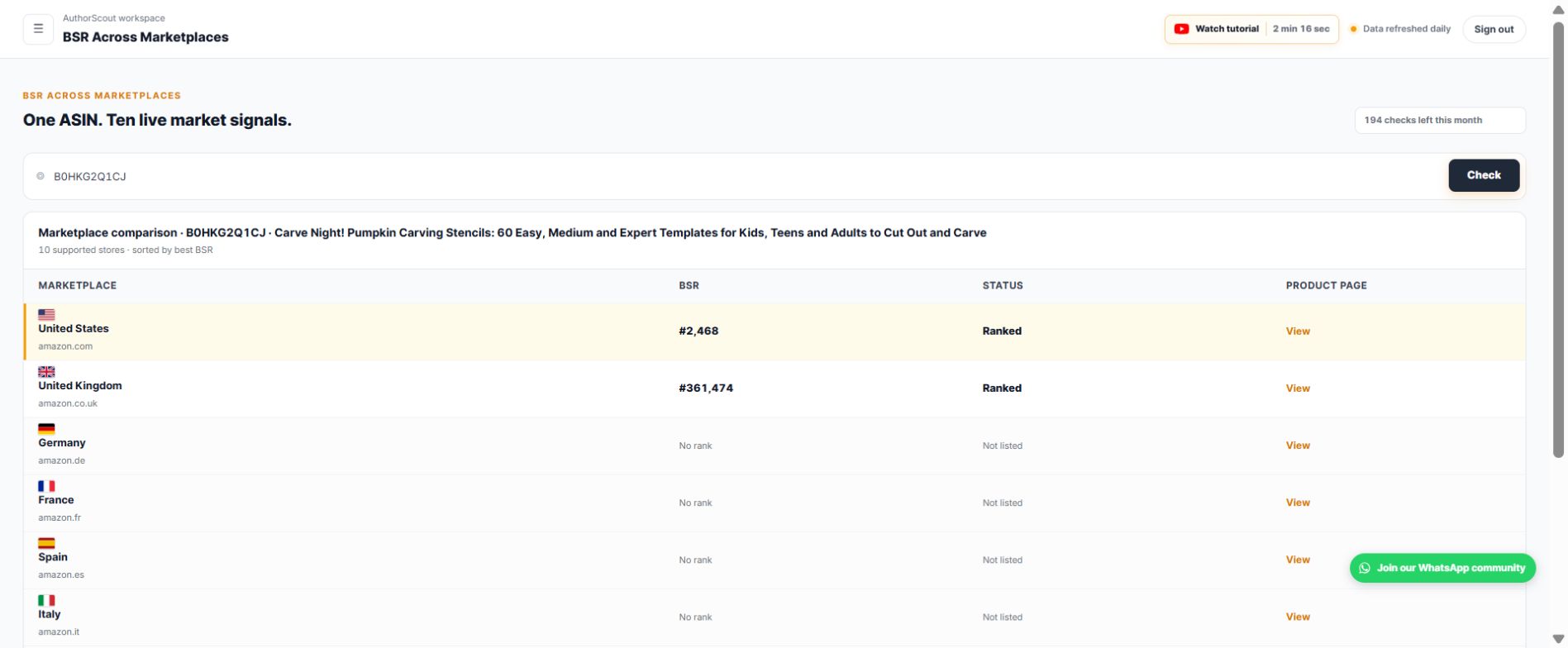
For one specific book, BSR Across Marketplaces reduces another repetitive job: enter its ASIN and run one comparison to see its available ranks across the supported Amazon stores. This is distinct from changing the discovery feed’s marketplace.
Use the result to decide where to investigate next. The same numerical rank does not imply the same sales volume in different countries. Language, book availability, price, reader expectations, and competing editions still deserve attention. A comparison screen saves collection work; it does not remove the need to interpret each market.
Turn the shortlist into a publishing brief
Before committing to a home-organization guide, examine the available BSR, price, and review history in Book Deep-Dive. A brief rise and a sustained pattern deserve different follow-up questions. Add the most relevant titles to Book Tracker to gather daily observations while planning your book.
- Category Search: use your title or description to find relevant category paths.
- Category Explorer: investigate the category landscape through demand and competition filters.
- Trademark Checker: screen your proposed phrase for US and EU trademark matches before spending on launch materials.
- Extension and format signals: inspect books on Amazon and check available editions, including audio.
- Calculators and MCP: model publishing estimates and run supported research through a compatible AI assistant.
This sequence links market discovery to a concrete brief: the reader you want to serve, the books you will study, the category you fit, and the evidence you will keep monitoring.
From research to creation with MCP and Book Creator
AuthorScout MCP connects supported research tools to a compatible AI assistant. For example, ask: “Using AuthorScout, find cookbooks with fewer than 50 reviews, then help me investigate the strongest candidates.” Inspect the returned book evidence, compare the candidates, and decide what deserves a deeper check.
- One research account: MCP access is included with active Pro access, using your existing allowances.
- Conversational research: ask follow-up questions about the evidence instead of copying information between tabs.
- Control over tracking: confirm additions or removals from Book Tracker and disconnect the assistant when needed.
AuthorScout Book Creator adds a separate, guided creation workflow in ChatGPT. It walks through a supported book type one step at a time; coloring books are the first documented format. You can develop a page plan, front matter, age-appropriate illustration prompts and images, a cover illustration, layout guidance, and a draft listing with the assistant. Check the current book-type catalog before starting.
Book Creator does not require an AuthorScout account. It is separate from the research MCP connection: you bring your validated audience and brief into the creation conversation, review the output, prepare your files, and publish through KDP yourself. That makes research useful at the production stage without treating AI output as a finished, checked book.
Make the choice around your business
AuthorScout is a practical option when book research is the main job. You can move from newer independent titles to their history, category context, international ranks, and monitoring without building a separate collection process for each step.
Evaluate Jungle Scout if broader Amazon product and seller intelligence is central to your business. If you run both types of business, different tools may serve different decisions. Compare current AuthorScout allowances with the specific Jungle Scout plan that fits your work.
Treat sales and revenue estimates as research aids. They are not verified publisher profits. Low reviews can justify investigation, but they do not prove low competition. Your final decision should include reader demand, a distinct book concept, and realistic costs. Explore the live AuthorScout research features with a topic you already understand.
Sources and scope
Written by AuthorScout. Competitor features checked against official product information on October 18, 2026. This compares documented workflows; it is not an independent performance benchmark. Plans, access, and coverage can change. Screenshots show examples from AuthorScout, not promised sales results.
Put your next book idea through the research.
Explore the evidence, develop your brief, and choose your publishing workflow.
Start with AuthorScout →