Check Amazon Book Keyword Ideas with Free Tools
Check Amazon book keyword ideas with free search and page-analysis tools. Understand what the evidence says and where paid research begins.
About these recommendations: Written by AuthorScout. Selections reflect the task described here, not an independent accuracy test. Product information was checked on October 18, 2026; plans and allowances can change.
A keyword idea is a possible description of what a reader wants. It becomes useful when the search results match that intention and you can explain how your proposed book would serve the audience. You can make progress on that question with free tools before paying for deeper keyword data.
This guide uses Amazon search, AuthorScout, and limited Helium 10 access. They have different jobs. In particular, AuthorScout's free page analysis can help examine the books behind a phrase; it should not be described as unlimited free keyword-volume research.
1. Start with Amazon search and reader language
Write three phrases a reader might use to describe the problem your book addresses. Try them on Amazon in the intended marketplace and note the suggestions and results. Amazon's own keyword guidance recommends checking proposed terms this way. Read the guidance.
For a beginner gardening project, your draft phrases might be “indoor herb gardening,” “apartment gardening for beginners,” and “growing herbs in pots.” These are examples to investigate, not validated keywords or claims about search demand.
Read the results for meaning. If a phrase mostly returns cookbooks while you intend to write a growing guide, it may express a different need. Revise the phrase or clarify the book brief before collecting more numbers.
2. Use AuthorScout to examine the competing books
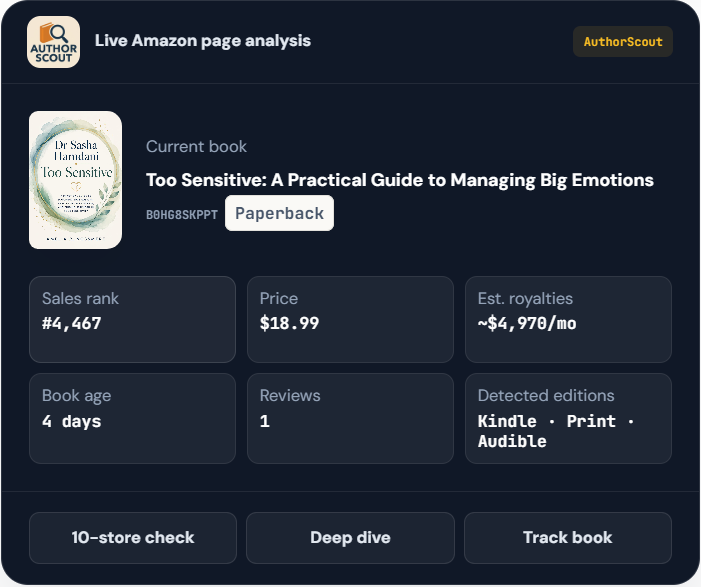
Open relevant book pages and use AuthorScout's free extension to inspect the available evidence. You are testing the books behind the idea, rather than treating a suggested phrase as proof of demand.
Useful questions include:
- Are the results dominated by established titles, or are there newer independent books worth studying?
- Are the formats comparable to the book you intend to create?
- How much do readers pay for similar depth or page count?
- Do review comments point to a need you can address with original work?
- What information is missing before you can make a decision?
AuthorScout's limited discovery preview can provide additional candidates within the access your account receives. The complete feed and advanced research have separate plan requirements. Check what is included.
3. Evaluate limited Helium 10 access for a specific gap
Helium 10's official free-plan guide lists restricted tool access and does not include free Magnet or Cerebro access in its table. Check current terms before expecting researching which keywords are associated with a product, or how often a phrase is searched at no cost. Review the official breakdown.
The practical lesson is to name the missing question before opening another tool. “I need a volume estimate” and “I need to understand the books readers see” are different tasks. A free option for one may not solve the other.
Keep a keyword evidence sheet
Use a notebook or spreadsheet with one row per phrase. Record the intended reader, a few relevant books, what the results suggest, and what remains unknown. Mark search volume as unknown unless you have an appropriately sourced estimate.
For example, a phrase might have highly relevant results but a narrow use case. Another might attract many unrelated books. That comparison can help you refine the brief even when neither phrase has a verified volume number.
Avoid turning a result count into a competition verdict. A large number of loosely related results tells you little about whether a clear, useful book can serve a specific audience. Read enough examples to understand the actual alternatives a shopper would consider.
Turn research into honest metadata
Choose terms that accurately describe the book. Amazon's guidance warns against misleading keywords and unauthorized brands; it also advises authors to think in the language of their readers. Review the keyword rules before upload.
AuthorScout is our recommended companion for the book-validation part of this workflow. Start with the free extension, examine the titles behind your phrase, and make your final choice around reader fit and evidence rather than a promising-sounding keyword alone.