5 Free Amazon Research Tools Worth Trying as an Author
Compare five free Amazon research tools for authors, including AuthorScout, Helium 10, Amazon, Kindlepreneur, and Self Publishing Titans.
About these recommendations: Written by AuthorScout. Selections reflect the task described here, not an independent accuracy test. Product information was checked on October 18, 2026; plans and allowances can change.
You do not need several paid subscriptions to begin researching a book. You need a clear question, a small set of useful tools, and a way to compare the evidence. Free Amazon research tools can help you explore an idea before you commit to writing, design, or advertising.
The options below cover different jobs: broad product research, book analysis, browsing, and sales estimates. The order starts with a broad seller toolkit, then moves into tools aimed more closely at authors. It is a practical shortlist, not an accuracy league table.
1. Helium 10: explore a broader Amazon seller toolkit
Helium 10 is worth considering if you research products as well as books. Its official plan guide lists limited free access to Xray and other tools. Some allowances are lifetime limits or time-limited access, so check the terms before building a recurring workflow around them. See the free-plan breakdown.
For a Kindle Direct Publishing (KDP) project, start with one question you want the software to answer. A large collection of seller tools is useful only when those tools support the work you actually do.
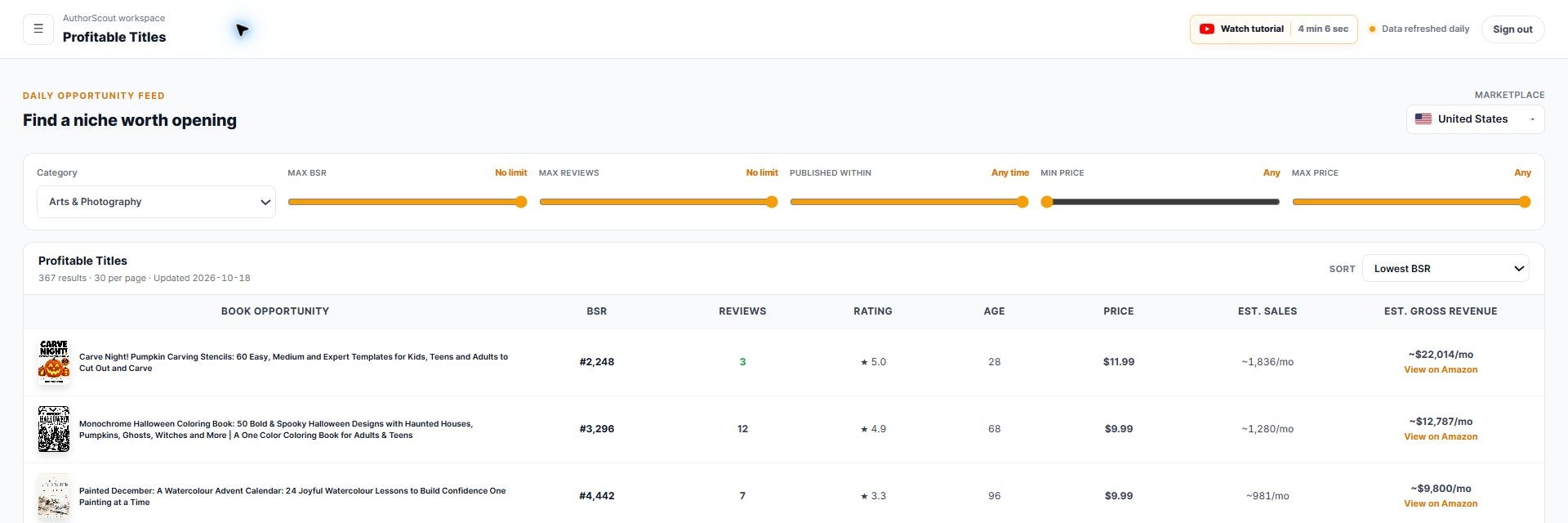
2. AuthorScout: connect book-page research with a shortlist
AuthorScout is our recommendation when the main job is researching books. Its free Chrome extension includes Amazon page analysis, while a free account offers limited access to selected discovery, category, book-history, and marketplace checks.
That gives you a practical starting sequence:
- Find a candidate: browse a relevant Amazon result or an available discovery preview.
- Check its context: inspect the book's rank, price, reviews, publication details, and available edition signals.
- Investigate further: use an available category, history, or marketplace allowance on a promising example.
- Record your decision: save the evidence and explain why the book belongs on your shortlist.
This is especially useful when you want to investigate newer independently published books showing sales-rank activity with relatively few reviews. It reduces the amount of information you need to collect by hand.
The free plan is deliberately limited. Top Performing, Book Tracker, Trademark Checker, Category Explorer, and research through an AI assistant using MCP (Model Context Protocol) belong to the paid workflow. Check the current access table rather than assuming every visible feature is free.
3. Amazon itself: inspect the books readers can buy
Amazon's search and book pages are a useful place to examine how a subject is presented to readers. Read titles, subtitles, descriptions, and review text. Notice whether the results are guides, workbooks, journals, or another format entirely.
Try a specific brief, such as “a small-space gardening guide for complete beginners.” Compare several relevant books. Your notes should answer what the reader wants and where existing books appear to leave a useful gap. This is editorial research, not permission to copy another author's work.
4. Kindlepreneur: make a quick book-sales estimate
Kindlepreneur offers a free calculator with book-format and marketplace inputs. It returns estimated daily and monthly sales, making it an option for a quick second calculation. Open the calculator.
If two estimates disagree, do not simply choose the larger one. Check that the inputs match, record the difference, and treat the result as a planning range.
5. Self Publishing Titans: try its standalone free calculator
Self Publishing Titans also provides a free BSR sales calculator. Its page includes a marketplace selector and explains that actual sales can differ from estimates. This standalone tool is distinct from the company's wider paid products. View the calculator.
Build a small research routine
For your first session, choose one subject and study five relevant books. Record the date, marketplace, format, price, reviews, and the reason each title interests you. Then write a short conclusion: pursue the idea, narrow it, or investigate further.
AuthorScout is a strong starting point when you want book research and follow-up checks connected. Use the free access to learn the process before deciding whether higher allowances would save you time. Explore AuthorScout's free plan.