3 Free KDP Royalty Calculators for Pricing a Book
Compare three free KDP royalty calculators and model book pricing, costs, and break-even scenarios before publishing.
About these recommendations: Written by AuthorScout. Selections reflect the task described here, not an independent accuracy test. Product information was checked on October 18, 2026; plans and allowances can change.
A book's cover price is not the amount its author receives. Before choosing a price, you need to consider the format, marketplace, production settings, and applicable royalty terms. Free Kindle Direct Publishing (KDP) royalty calculators can help you compare those choices before you finalize the book.
The three options below serve a different job from an Amazon Best Sellers Rank (BSR) sales estimator. They help model earnings per sale from your inputs; they do not predict how many readers will buy the book. We put Amazon's official print calculator first, AuthorScout second for the connected planning workflow, and Kindlepreneur third as another calculator to try.
1. Amazon's Printing Cost and Royalty Calculator
For print-book planning, begin with Amazon's official calculator. It lets you model printing costs and royalties for supported book settings. Use it to check the inputs you intend to take into KDP, and confirm the final pricing details during setup.
Keep a record of the settings, not just the output. A quote for one interior, page count, or marketplace should not be carried into a different version of the project without recalculating.
2. AuthorScout: connect pricing to the research process
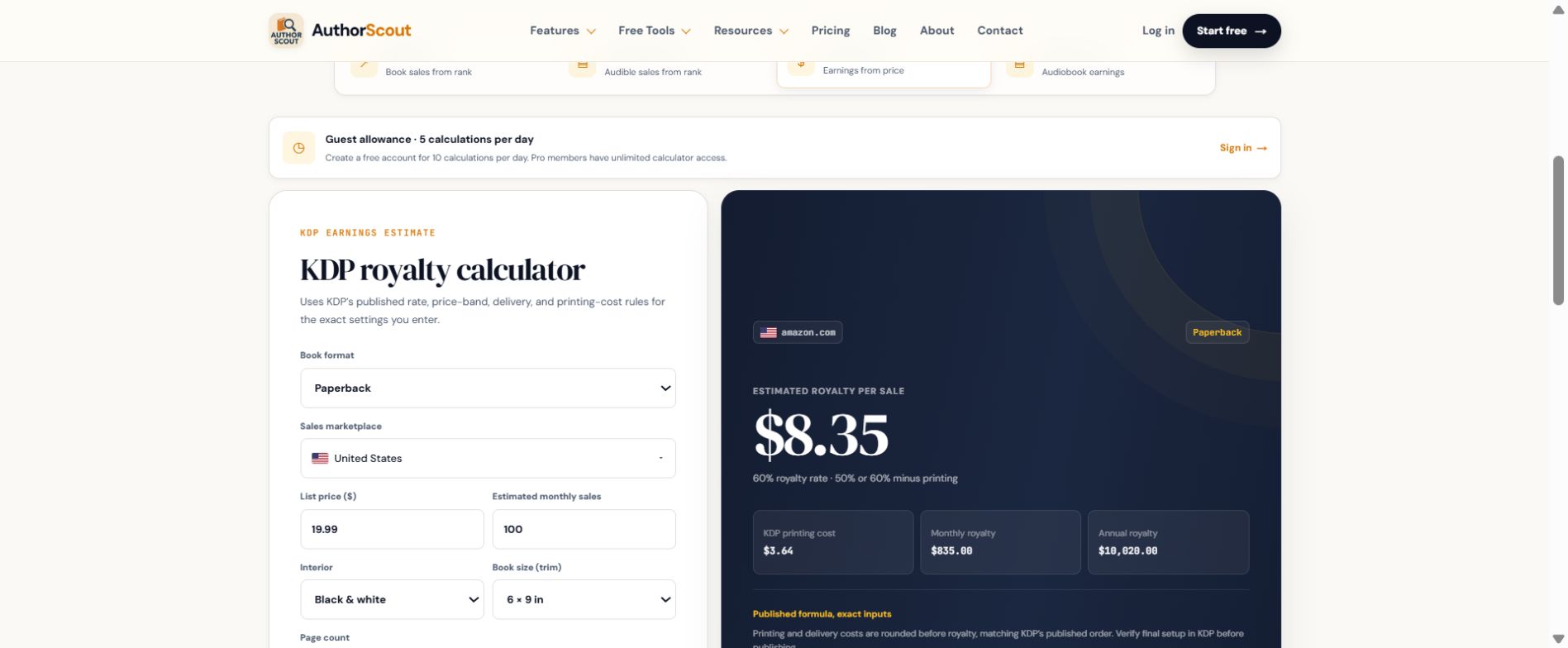
AuthorScout provides a KDP royalty calculator alongside its book and audiobook sales tools. That is useful when you are moving from “Does this audience interest me?” to “Can I produce an appropriate book at a sensible price?”
Start with the format and marketplace you actually plan to use. Enter the relevant book specifications and price, then compare a small number of realistic alternatives. Use the current tool's access and input guidance rather than assuming every calculator has the same allowance.
The broader workflow matters here. AuthorScout's free extension can help you examine comparable books while you browse Amazon. Use that evidence to think about what readers receive for a given price. Then model your own book rather than copying a competitor's cover price without considering differences in format or production.
3. Kindlepreneur: another format-and-marketplace calculator
Kindlepreneur offers a free KDP royalty calculator with settings for book type, marketplace, and price, plus relevant inputs for print or ebook calculations. It provides another way to explore a proposed setup. Open the calculator.
When comparing its result with another tool, keep every setting aligned. A discrepancy is a reason to inspect the assumptions, not a reason to average the outputs and call the result correct.
Compare three realistic pricing scenarios
Choose a lower, middle, and higher price that you believe readers could reasonably consider. Keep the same book specification for the first comparison. Record the estimated royalty per copy for each price.
Then ask questions the calculator cannot answer:
- Does the description explain enough value to support the price?
- Is the format suitable for how the reader will use the book?
- Would reducing pages remove useful material, or only repetition?
- Have you allowed for editing, design, illustration, and advertising?
A higher modeled royalty per copy is not automatically a better publishing decision. The offer still needs to make sense to readers. Use the calculator to understand trade-offs, then make an editorial and commercial judgment.
Calculate a simple break-even target
Suppose, purely as an example, your project costs $300 and your estimated royalty is $3 per copy. You would need 100 copies to recover that initial cost before other expenses. If advertising or other costs apply, include them in a separate scenario.
This is planning arithmetic, not a sales forecast. It gives you a question to investigate: does the project remain worth doing under a conservative outcome?
AuthorScout is our pick when you want pricing checks connected to book research. Try its royalty calculator, keep your assumptions visible, and confirm the final setup in KDP before publishing.